

The prevalence of vaping among school-aged children continues to rise across the UK, with recent statistics showing nearly one in five young people aged 11-17 have tried vaping. As you work to address this growing challenge in your school, understanding the locations where students try to hide vaping has become increasingly important for developing your prevention strategies.
Your students can be remarkably creative when concealing their vaping activities, employing various tactics to avoid detection, and this cat-and-mouse game makes it essential for you and your staff to stay informed about common hiding spots and techniques.
Once you know where to look, you can then start implementing more targeted monitoring and detection solutions to help maintain a healthier learning environment in your school.
School Toilets: The Primary Vaping Hotspot
Vaping in school bathrooms remains the most common practice among students seeking to indulge their habit during school hours. The privacy these spaces afford makes them particularly attractive for vaping activities in your school. You might find students gathering in groups, with some serving as lookouts while others take turns using the devices.
In your toilet cubicles, students might create improvised ventilation systems by blowing vapour into toilet paper holders or using the hand dryer to disperse the aerosol. You might even discover some even run the shower or hot taps to create steam that masks the vapour cloud. Irrespective of specific techniques used, the point is that vaping in school toilets is challenging to stop, given the lack of regular supervision for privacy reasons. Without the proper technological solutions, vaping in these spaces can be very difficult to detect and stay on top of.
Beyond Toilets: Other Common Vaping Locations
While toilets might be the most obvious location in your school, they’re certainly not the only places where students hide vapes and engage in vaping activities. Changing rooms present similar advantages to toilets, offering privacy and infrequent supervision. Your students might use their PE lessons or sports activities as opportunities to vape, knowing your staff presence might be limited or intermittent.
Stairwells and isolated corridors, particularly those in older parts of your school building or less-trafficked areas, provide convenient spaces for quick vaping breaks between lessons. These locations often feature blind spots that your CCTV cameras might not capture. Outdoor spaces around your school perimeter, including bike sheds, the backs of sports facilities, and areas behind outbuildings, also offer your students places to vape during break times or lunch periods. Some of your students might even slip off-site briefly if your school has multiple entrances or a large campus.
Lastly, empty classrooms or temporarily unsupervised spaces can become impromptu vaping locations when your students know a room will be vacant for a specific period, such as during staff meetings or assembly times.
How Students Conceal Vape Devices
Knowing where your students vape is only half the challenge. Understanding how they conceal their devices can help you identify potential vaping activities before they occur in your school.
Disguised Vape Designs
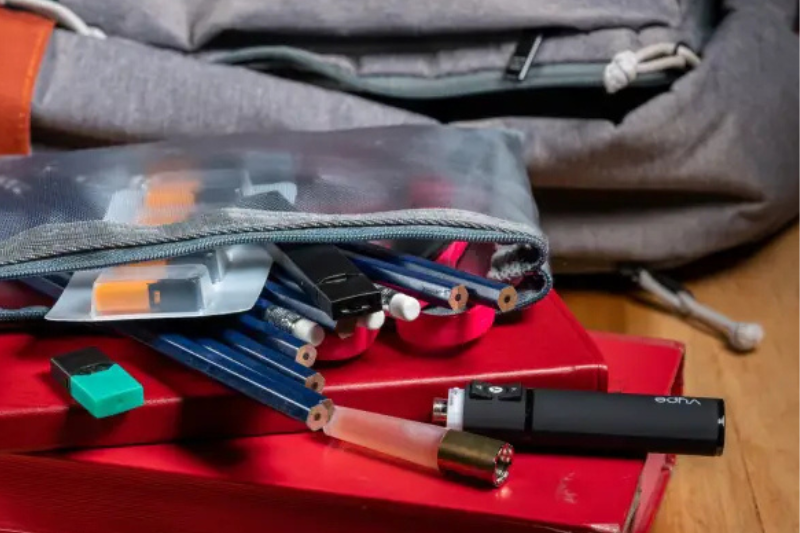
Modern vapes can be disguised as everyday items such as highlighters, USB sticks, or even watches. These devices can sit in plain sight on your students’ desks without raising your suspicion. For instance, if you look at the Primal Hype Bar vape pen, it looks like a common highlighter, and it could be easy for you and your teachers to miss it during casual observation.
Vapes Hidden in Clothing
Your students might keep vapes in various clothing and accessory hiding spots. Inside jacket linings, socks, waistbands, bra cups, and specially sewn pockets all serve as concealment locations. Pencil cases, calculator covers, and hollowed-out books can also hide vaping equipment effectively from your view.
Vaping Hidden Through Social Concealment Tactics
Social concealment tactics include sharing a single device among multiple students, reducing the number of devices that might be discovered during your searches. Groups in your school might establish complex signals to warn of approaching staff or use social media platforms to coordinate vaping meetups in different locations throughout your school day.
Effective Detection Strategies for Preventing Vaping in Schools
With a clearer understanding of common hiding places, you can implement targeted strategies to address the issue in your school. Vape detection technology can transform your ability to monitor problematic areas. For instance, vape sensors placed in your toilets, changing rooms, and other identified hotspots can alert you and your staff to vaping activity in real-time, enabling your prompt intervention. Systems, such as those developed by Volan, can significantly reduce the appeal of these locations for your students considering vaping since they know they’ll likely be caught and reprimanded.
Of course, technological intervention always works best when combined with other supporting school policies. For example, you could take a more strategic approach to staff monitoring, increasing their presence near known vaping hotspots during break times and lesson changeovers. Adjusting your duty schedules to include previously overlooked areas can also help to disrupt established vaping patterns and create uncertainty for students attempting to vape in your school.
How to Implement Comprehensive Vaping Prevention in Your School
As we’ve covered previously, understanding how to prevent vaping in schools requires you to take a multi-faceted approach that combines detection, education, and policy. Yes, technology plays a crucial role, but you should use it to complement rather than replace your other prevention efforts. A clear anti-vaping policy communicated to your students, staff, and parents should be the starting point, establishing expectations and consequences. Your policy might include graduated responses that balance disciplinary measures with supportive interventions for students struggling with nicotine addiction.
Educational initiatives that honestly address the health risks associated with vaping can also help your students make informed decisions. You’ll find these programmes prove most effective when they avoid scare tactics in favour of evidence-based information delivered in age-appropriate formats for your school population. Finally, parental engagement through your newsletters, workshops, and information sessions can extend your prevention efforts beyond school grounds. When your families understand the risks and signs of vaping, they can reinforce your school’s message at home.
Given the scale of the teen vaping epidemic, it’s naive to think you can completely stamp it out of your school, but these efforts, along with vape detection equipment, can significantly reduce vaping on school premises and improve the potential health outcomes for your students.
Monitor School Vaping Hotspots with Technology Solutions from Volan
Volan’s advanced vape detection systems offer your school a powerful tool in addressing the challenges outlined above. Our UK-made sensors provide precise, real-time alerts when vaping occurs in your facilities, helping you respond promptly to incidents and gather valuable data about vaping patterns in your school. Paired with effective school policies, our vape sensors have already been proven to reduce vaping incidents within educational establishments across the country.
So, please contact our team today for a free consultation to learn more about how we can support your school’s efforts to create a healthier, vape-free learning environment for your students.